


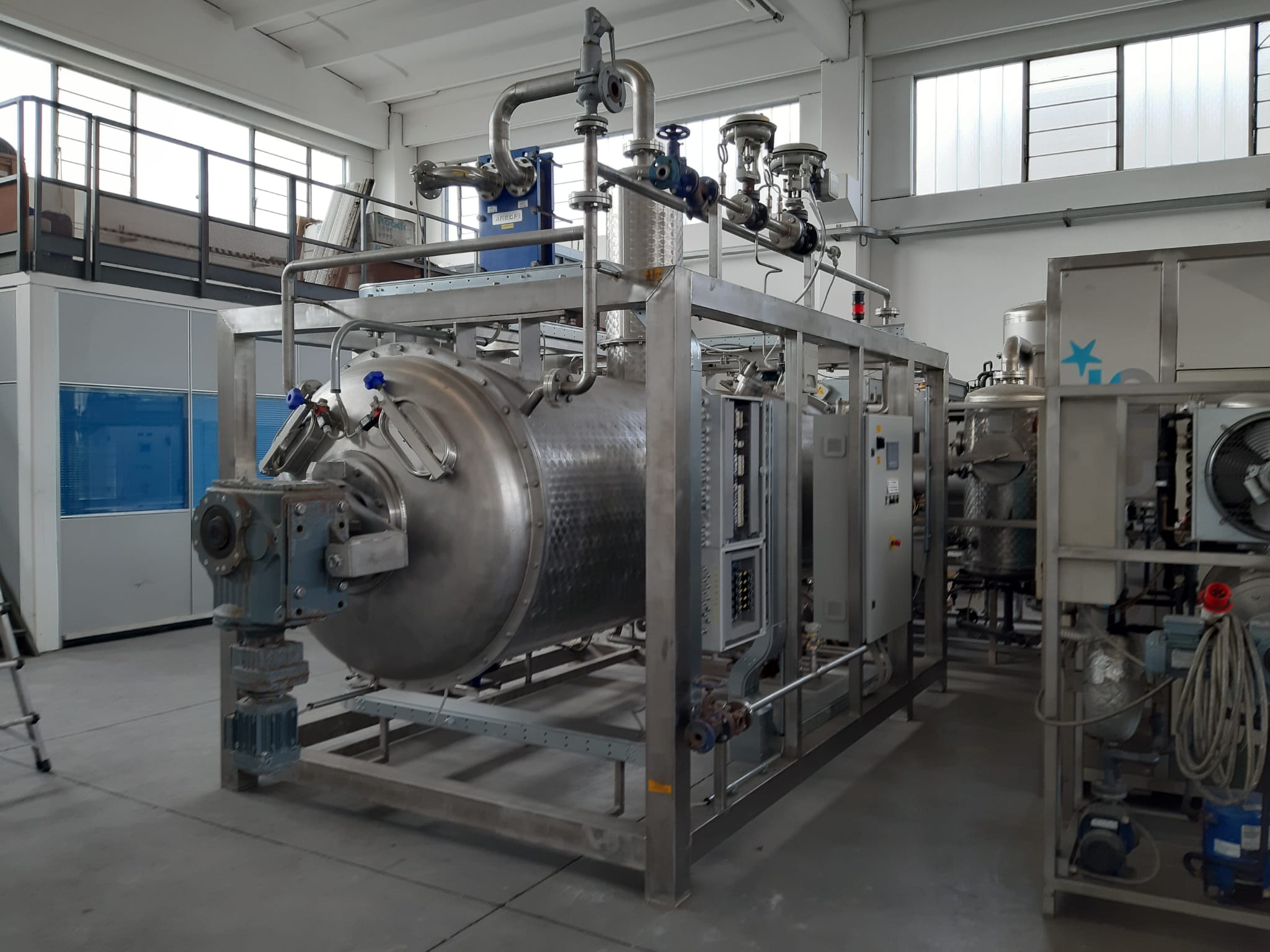
- Crystallization driven by hot water or steam
- Highest capacity rates
- Different models to cover all types of streams
AVAILABLE MODELS AND MAIN TECHNICAL CHARACTERISTICS
Our thermal crystallizers concentrate high-salinity industrial wastewater and crystallize dissolved salts, supporting water recovery and liquid waste minimization in Zero Liquid Discharge (ZLD) systems.
Using steam or hot water as the heat source, these systems are particularly attractive for facilities with suitable waste heat or existing thermal utilities. Their operating costs depend on the availability, temperature and cost of the heat source, as well as the cooling requirements.
We manufacture four models that cover the whole range, DESALT VR, DESALT DRY, DESALT MFE-1, and DESALT VTR. We help you select the most suitable model and configuration based on your wastewater composition, treatment capacity, available utilities and final concentrate requirements.
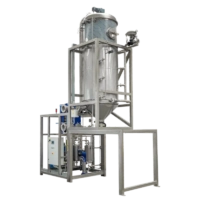
Technology: Evaporation with thermal energy
Capacity (l/day): 2000 to 20000
Electricity consumption per 1 m³ of distillate produced: 4,2 to 5 kWh/m³
Thermal energy for evaporation: Saturated steam or hot water
Thermal energy for condensation: Cooling water
Vacío: ≈ 200 mbar
Evaporation temperature: ≈ 60 °C
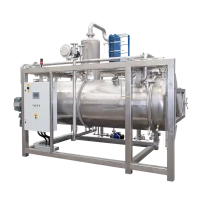
Technology: Evaporation with thermal energy
Capacity (l/day): 500 to 3000
Electricity consumption per 1 m³ of distillate produced: 2,7 to 7,4 kWh/m³
Thermal energy for evaporation: Saturated steam or hot water
Thermal energy for condensation: Cooling water
Vacuum: ≈ 200 mbar
Evaporation temperature: ≈ 60 °C
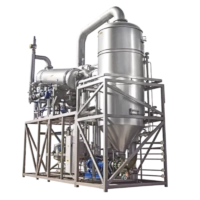
Technology: Evaporation with thermal energy
Capacity (l/day): 20000 to 100000
Electricity consumption per 1 m³ of distillate produced: 26 to 48 kWh/m³
Thermal energy for evaporation: Saturated steam or hot water
Thermal energy for condensation: Cooling water
Vacuum: ≈ 200 mbar
Evaporation temperature: ≈ 60 °C
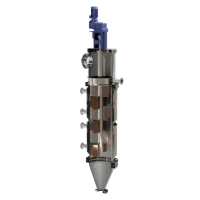
Technology: Evaporation with thermal energy
Capacity (kg/day): 10000
Electricity consumption per 1 m³ of distillate produced: 5,5 kWh/m³
Thermal energy for evaporation: Saturated steam
Thermal energy for condensation: Cooling water
Vacuum: N/A
Evaporation temperature: ≈ 100 °C (Patm)
KEY ADVANTAGES
- Versatility in complex effluent treatment: Configurations tailored to different wastewater compositions and concentration requirements, including demanding industrial applications.
- The widest capacity range: Models covering treatment capacities from 500 to 100.000 liters /day, allowing selection according to each facility’s requirements.
- Potential for lower OPEX: Suitable waste heat or low-cost thermal energy can reduce evaporation costs, particularly in applications with sustained treatment demand.
MAIN COMPONENTS
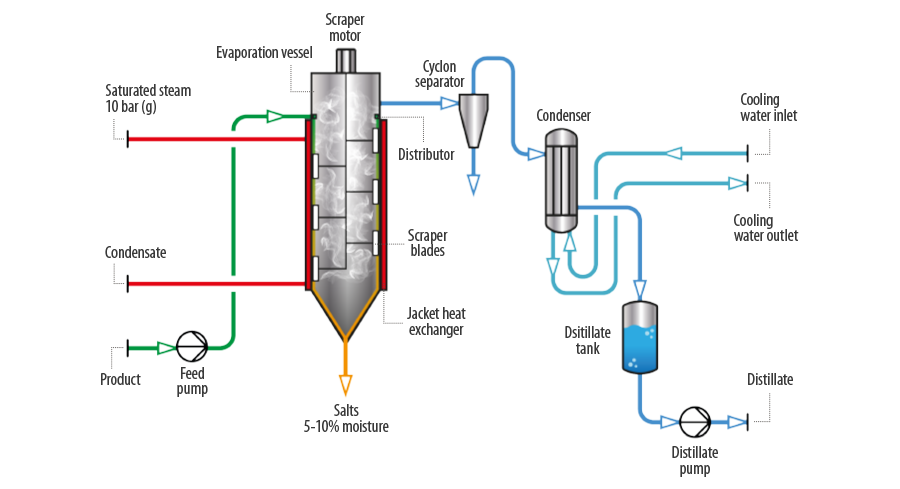
OPERATION OF OUR THERMAL CRYSTALLIZERS
External heat supply
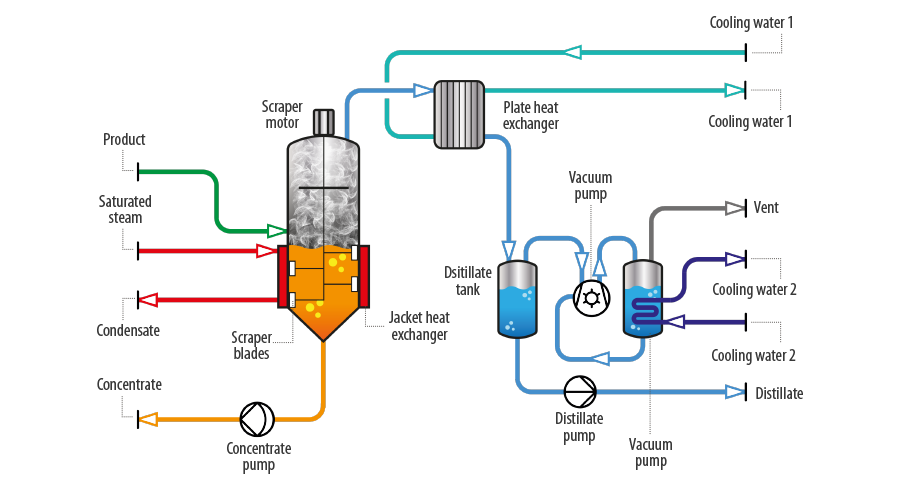
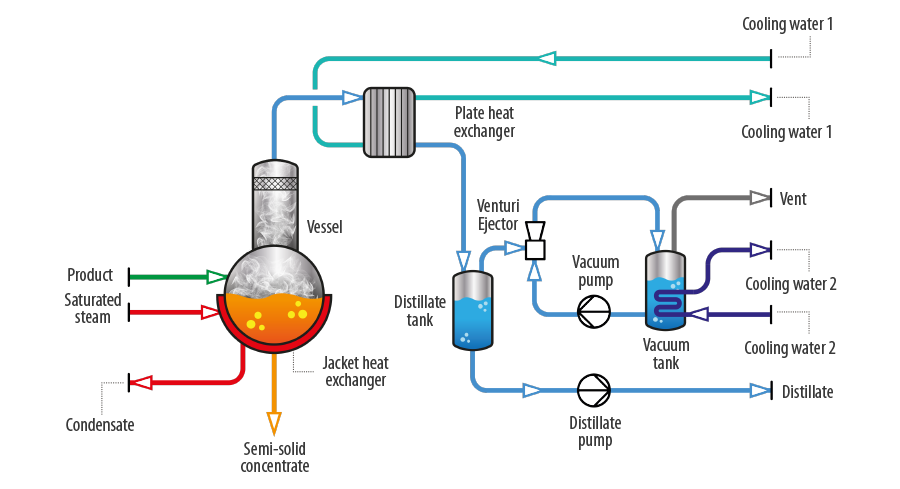
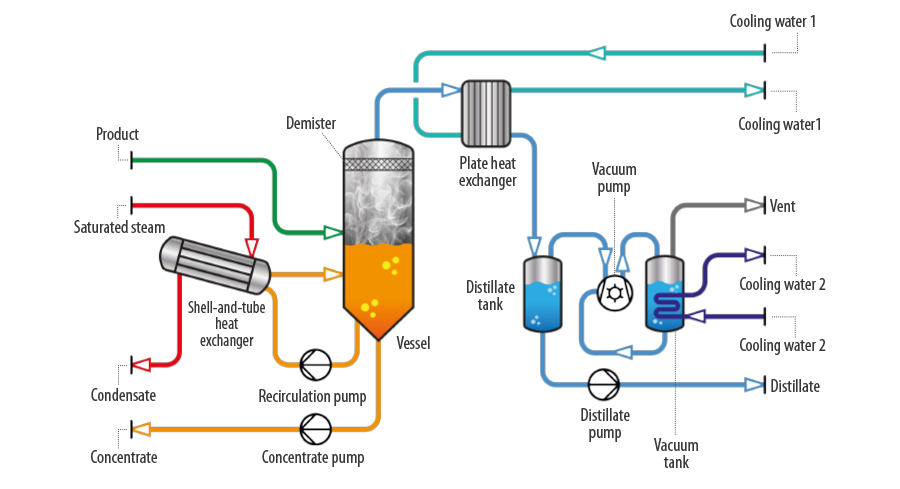
An external heat source, such as steam or hot water, transfers thermal energy to the wastewater through a heat transfer surface. This energy heats the liquid and drives evaporation. Suitable waste heat can also be used when its temperature and availability meet the process requirements.
Water evaporation and concentration
As heat is supplied, part of the water evaporates, increasing the concentration of dissolved salts and other nonvolatile substances in the remaining liquid. Depending on the system design, evaporation takes place under vacuum or at atmospheric pressure. Vacuum operation allows boiling at lower temperatures.
Crystal formation and growth
As evaporation continues, crystallizable salts reach supersaturation and begin to form and grow as solid crystals. Operating conditions are controlled to support crystallization and maintain effective heat transfer as the mixture becomes more concentrated.
Condensation and residue recovery
The generated vapor is condensed to recover water for potential reuse, subject to the required quality. The concentrated residue is withdrawn as a crystal slurry, a semi-solid material or a solid product, depending on the equipment and wastewater composition. Further separation or drying may be required to obtain the desired final product.
MODEL SELECTION
| Your application or priority | Suggested model | Key selection advantages | Published capacity* |
|---|---|---|---|
| Scaling effluents requiring high concentration and mechanical cleaning of heat transfer surfaces | DESALT VR | Internal motorized scraper helps control deposits on heat transfer surfaces. Operates under vacuum using steam or hot water. | 2,000–20,000 L/day |
| Smaller volumes where the objective is a solid or semi-solid concentrate | DESALT DRY | Designed for advanced concentration. An optional internal screw homogenizes the product and facilitates discharge. Uses steam or hot water under vacuum. | 500–3,000 L/day |
| Large wastewater volumes requiring salt crystallization and forced circulation | DESALT MFE-1 | High-speed recirculation supports heat transfer and helps limit scaling. Suitable for high-load aqueous streams, using steam or hot water under vacuum. | 20,000–100,000 L/day |
| Saturated salt solutions or high-solids streams requiring further moisture reduction | DESALT VTR | Steam-heated atmospheric configuration designed to maximize final concentration. Available with a condensation section when water recovery is required. | 10,000 kg/day per unit; parallel installation available |
*VR, DRY and MFE-1 capacities are published reference values based on clean-water operation under standard conditions. Actual wastewater throughput depends on feed composition and the required concentration. VTR capacity is stated in kg/day and should not be directly compared with L/day.