- Highest capacity rates
- Thermal energy: hot water or steam
- One, two and three effects available
AVAILABLE MODELS AND MAIN TECHNICAL CHARACTERISTICS
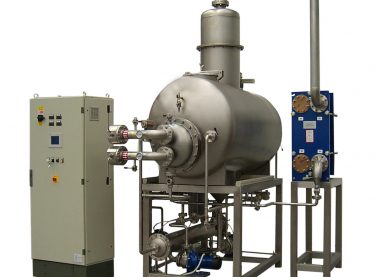
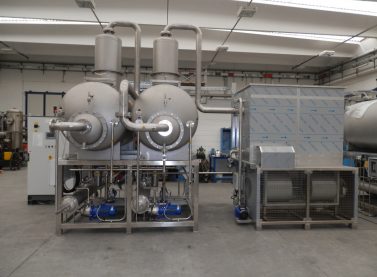
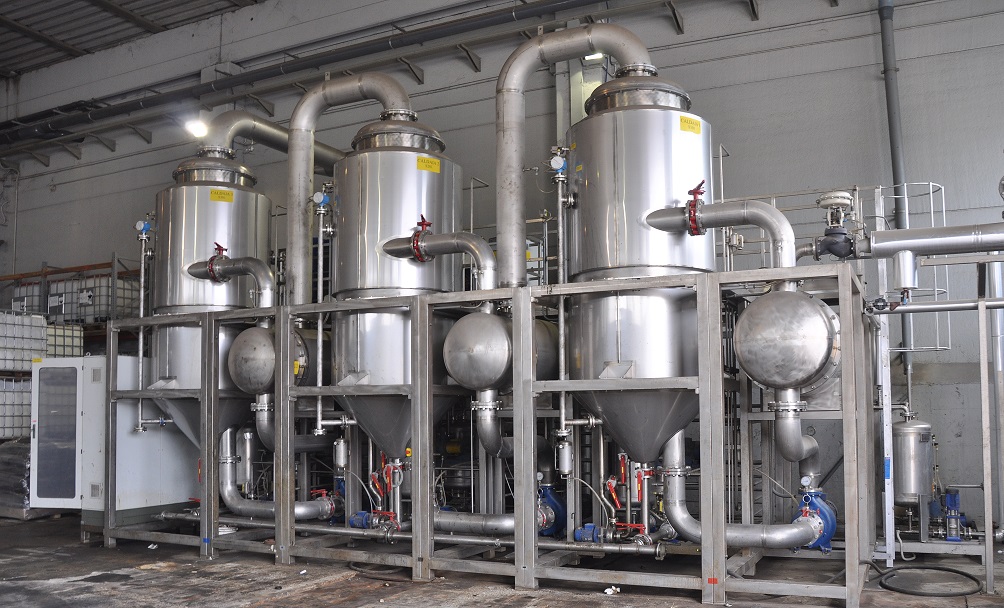
We supply two different models of multiple effect evaporators, Envidest DPM and Envidest MFE, eah one of them available with one, two and three stages.
Multi-stage evaporators operate with thermal energy (hot water or steam) and are the best option to treat large volumes of liquid waste.
This type of evaporator is specially recommended for industries with continuous operation or available waste heat, where operating cost savings outweigh higher initial investment.
We manufacture two different models:
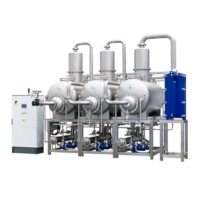
Technology: Evaporation with thermal energy
Capacity (l/day): 4000 to 30000
Electricity consumption per 1 m³ of distillate produced: 4 to 12 kWh/m³
Thermal Energy for Evaporation: 130 to 315 kWht
Thermal Energy for Condensation: 130 to 315 kWht
Vacuum (1st/2nd/3rd Effect): ≈ 310/200/125 mbar
Evaporation temperature (1st/2nd/3rd Effect): ≈ 70/60/50°C
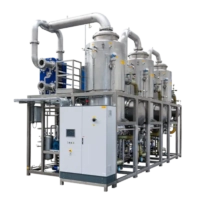
Technology: Evaporation with thermal energy Forced Circulation (FC)
Capacity (l/day): 20000 to 200000
Electricity consumption per 1 m³ of distillate produced: 20 to 110 kWh/m³
Thermal Energy for Evaporation: 630 to 2100 kWht
Thermal Energy for Condensation: 630 to 2100 kWht
Vacuum (1st/2nd/3rd Effect): ≈ 310/200/125 mbar
Evaporation temperature (1st/2nd/3rd Effect): ≈ 70/60/50°C
KEY ADVANTAGES
All our multi-stage evaporation systems deliver exceptional operational advantatges:
- Robust and reliable evaporator that can manage complex effluents in demanding industrial environments.
- Multiple effect vacuum evaporators optimize energy efficiency by reusing the vapor generated in each stage as the heating source for the next, operating under progressively lower pressures and temperatures.
- Excellent evaporator for very large capacities, specially when thermal energy is available.
MAIN COMPONENTS
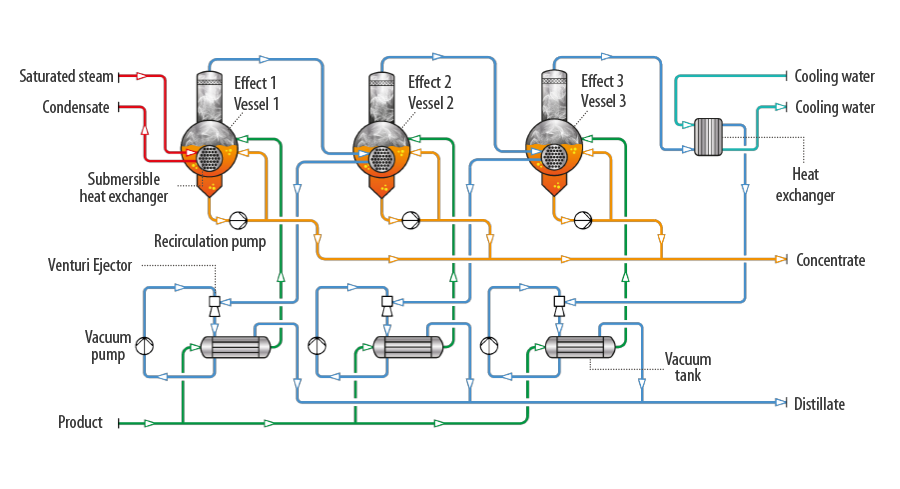
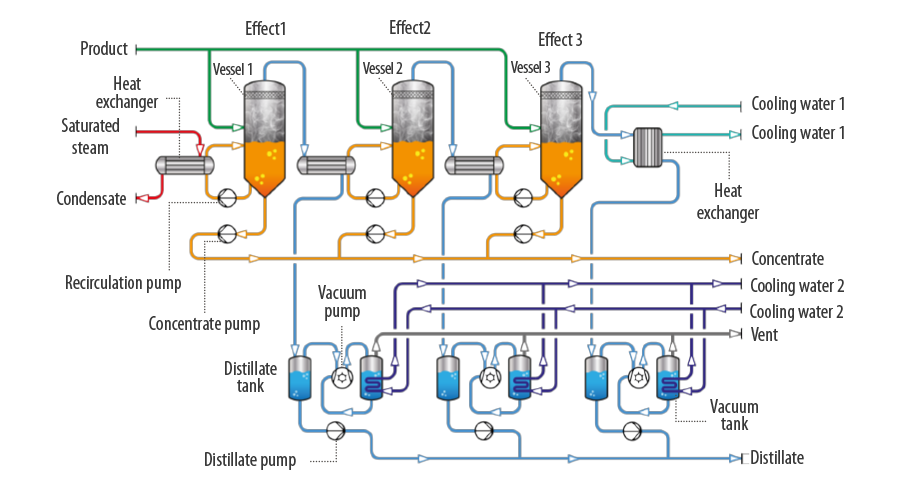
The following video shows some of our multiple effect evaporators:
OPERATION OF OUR MULTIPLE EFFECT VACUUM EVAPORATORS
External heat input and initial evaporation
The process begins in the first effect, which operates at the highest temperature and pressure of the system. The first effect is the only one that requires external energy.
When the feed reaches its boiling point, it generates the vapor that will become the heating medium for the next stage.
All subsequent effects reuse internally generated vapor.
Cascade evaporation through pressure and temperature gradient
The evaporator consists of different effects arranged in series. Each subsequent effect operates at lowest temperature and pressure than the previous one.
The vapor from one effect condenses in the heat exchanger of the following effect. The released latent heat causes boiling in that
next stage.
Energy reuse and efficiency amplification
Each kilogram of primary steam is reused multiple times. A 3-effect evaporator can produce aproximately three times more distillate than a single effect system with similar primary energy input.
This significantlly reduces specific energy consumption (kWh per cubic meter of distillate).
Final condensation and vacuum control
The vapor produced in the last effect is directed to a condenser connected to a vacuum system, where is condensed into distillate.
Non condensable gases are removed to maintain vacuum stability. The pressure diferential between effects ensures proper condensation and
boiling in each stage.
3D VIDEO ANIMATION
The following is a 3D video animation that shows step-by-step how our multiple effect evaporators work.
MULTIPLE EFFECT CONFIGURATIONS
We offer multi-effect evaporators with one, two, and three effects to adapt the solution to each client’s capacity, energy availability, and budget constraints.
Single-effect units are ideal for lower flows or when simplicity and lower CAPEX are priorities, while additional effects significantly reduce energy consumption by reusing latent heat.
Two and three effect configurations are designed for higher throughput and continuous operation, optimizing OPEX in the long term.