


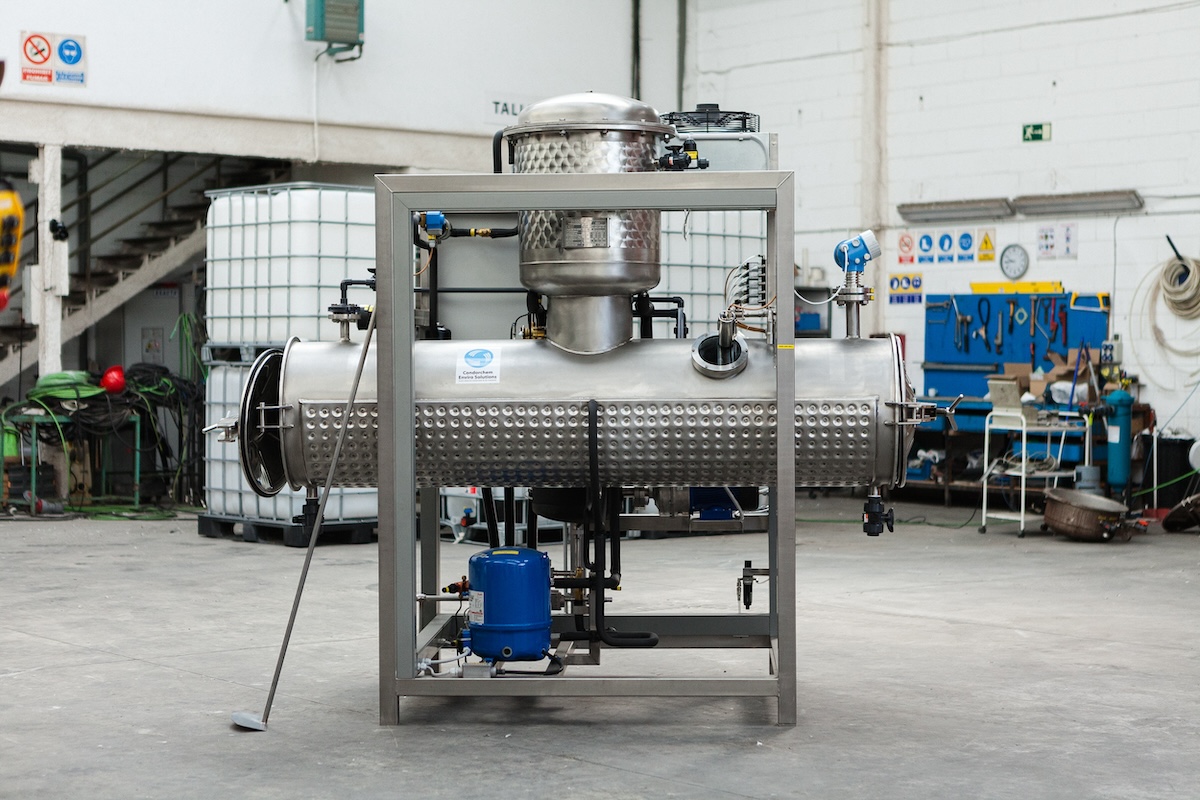
- Fully electrical operated crystallizers
- Low temperature operation
- Up to 90% of waste reduction and 99% of water recovery
AVAILABLE MODELS AND MAIN TECHNICAL CHARACTERISTICS
Our crystallizers take evaporation a step further by allowing the final concentrated brine to turn into solid crystals and recover the remaining water.
Thanks to its low vacuum temperature, our heat pump crystallizers are the perfect option for the evaporation of heat-sensitive and/or corrosive products, reducing the risk of thermal degradation of the product and the deterioration of construction materials.
Two models cover the heat pump range of crystallizators.
DESALT LT VR uses a scraped vertical vessel and handles the wider capacity band, making it the choice for continuous treatment of scaling streams.
DESALT LT DRY drives concentration further toward a dry solid, and suits applications where the objective is minimising the volume of residue or recovering a salt or metal in solid form.
Both are selected primarily where no thermal utility exists on site and installing one would cost more than the crystallizer itself.
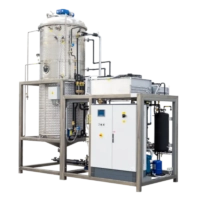
Technology: Heat pump (Freon R-513A)
Capacity (l/day): 250 to 3,500
Electricity consumption per 1 m³ of distillate produced: 220 kWh/m³
Vacuum: ≈ 60 mbar
Evaporation temperature: ≈ 35 °C
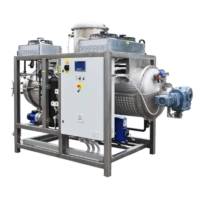
Technology: Heat pump (Freon R-513A)
Capacity (l/day): 250 to 1000
Electricity consumption per 1 m³ of distillate produced: 270 kWh/m³
Vacuum: ≈ 60 mbar
Evaporation temperature: ≈ 35 °C
KEY OPERATIONAL ADVANTAGES
- No thernal energy required. These units run on electricity, eliminating the need for a separate boiler or thermal oil circuit and simplifying installation and maintenance.
- Low-temperature operation. Evaporating at around 35 °C rather than at atmospheric boiling point reduces scaling rates, protects thermolabile compounds, and keeps the equipment outside the scope of pressure vessel regulation.
- Easier waste handling and water recovery. Internal mechanical devices help keep heat transfer surfaces clear and automatically discharge the crystallized residue. This reduces the volume of liquid waste requiring storage and transport while recovering water for potential reuse.
MAIN COMPONENTS
The following video provides a detailed overview of the design and key components of the DESALT LT DRY, one of our most widely deployed low-temperature vacuum crystallizers:
OPERATION OF OUR HEAT PUMP CRYSTALLIZERS
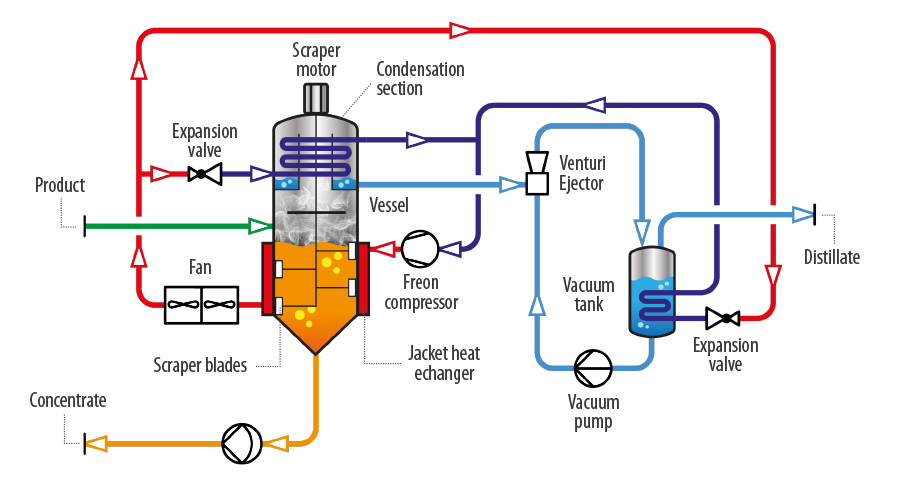
Vacuum generation and low-temperature boiling
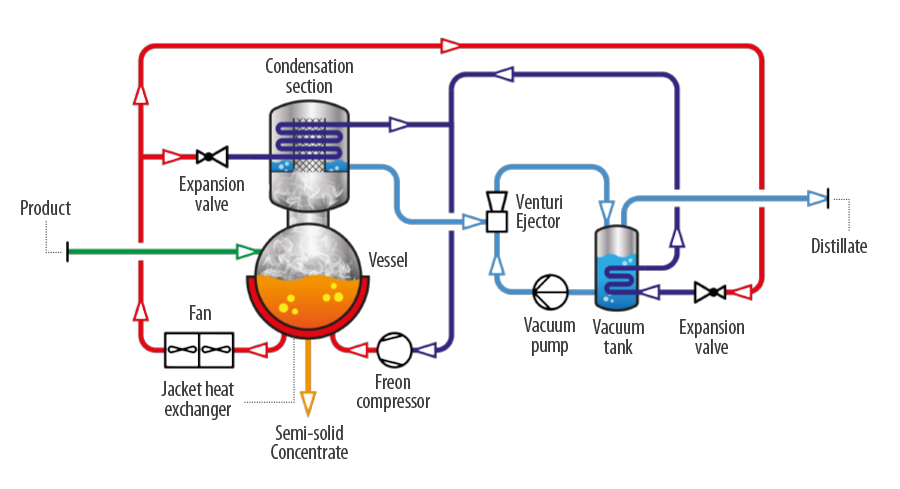
A vacuum is established inside the evaporation chamber, lowering the temperature required for boiling. The DESALT LT DRY operates at approximately 35 °C under nominal conditions, limiting heat exposure and reducing the risk of thermal degradation of temperature-sensitive compounds.
Heat pump heating and evaporation
A closed-loop heat pump supplies the energy needed for evaporation. The compressor raises the refrigerant’s pressure and temperature. The hot refrigerant then releases heat through the vessel’s heating jacket, causing water in the effluent to evaporate while the remaining solution becomes progressively more concentrated.
Vapor condensation and heat recovery
After releasing heat, the refrigerant passes through an expansion valve, lowering its pressure and temperature. It then absorbs heat from the water vapor in a separate heat exchanger, condensing the vapor into distillate. The refrigerant returns to the compressor, allowing the cycle to recover and reuse heat.
Crystallization and residue discharge
As water is removed, crystallizable salts reach supersaturation and form crystals. Further concentration produces a solid or semi-solid residue, depending on the effluent and operating conditions. Where fitted, an internal screw homogenizes the concentrate and facilitates automatic discharge, while the recovered distillate is collected separately.
MODEL SELECTION
| Your application or priority | Suggested model | Key selection advantages | Published capacity* | Electricity consumption* |
|---|---|---|---|---|
| Scaling effluents requiring high concentration and mechanical cleaning of heat transfer surfaces | DESALT LT VR | An internal motorized scraper helps control deposits on heat transfer surfaces during concentration and salt crystallization. Offers the wider capacity range of the two models. | 250–3,500 L/day | 220 kWh/m³ of distillate |
| Smaller volumes where the objective is a solid or semi-solid concentrate | DESALT LT DRY | Designed to produce solid or semi-solid residues. An optional internal screw homogenizes the concentrate and facilitates automatic discharge. | 250–1,000 L/day | 270 kWh/m³ of distillate |
*Published reference values based on clean-water operation under standard conditions. Actual throughput and energy consumption depend on wastewater composition, operating conditions and the required final concentration.