


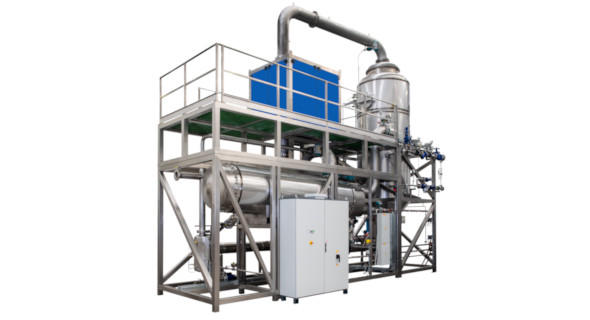
- Fully electrical
- High energy efficiency
- Lowest operating costs
AVAILABLE MODELS AND MAIN TECHNICAL CHARACTERISTICS
Our mechanical vapor recompression (MVR) crystallizers treat concentrated brines and high-salinity industrial wastewater, helping reduce energy consumption, recover water and minimize liquid waste within Zero Liquid Discharge (ZLD) systems.
The DESALT MVR FC combines mechanical vapor recompression with forced circulation to concentrate demanding aqueous effluents and crystallize dissolved salts. Each system is engineered around your wastewater composition, treatment capacity and water and resource recovery objectives.
By recompressing and reusing the vapor generated during evaporation, the system recovers heat to drive the process, reducing external heating requirements. This makes MVR particularly attractive for continuous operation, where energy consumption is a major contributor to operating costs.
The DESALT MVR FC is our mechanical vapour recompression crystallizer , built for aqueous streams carrying high contaminant loads and intended to precipitate salts from dissolved solids.
Technology: Mechanical Vapor Recompression (MVR) / Forced Circulation (FC)
Capacity (l/hour): 600 to 2,500
Electricity consumption per 1 m³ of distillate produced: 64 kWh/m³
Vacuum: ≈ 700 mbar
Evaporation temperature: ≈ 90 °C
KEY ADVANTAGES
- The lowest specific consumption in the electrical range: At 64 kWh/m³ of distillate across all models, a MVR crystallizer runs at roughly a third the energy cost of a heat pump unit, unbeateable when running continuosly.
- Forced circulation handles difficult streams. The recirculation pump keeps flow across the exchanger high enough to prevent scaling, so the unit is able to treat streams with high contaminant loads that would foul other models within hours.
- The highest capacity rates in the electric range. The MVR crystallizer range breezes past through what heat pump equipment can deliver while still requiring only an electrical connection in normal operation.
MAIN COMPONENTS
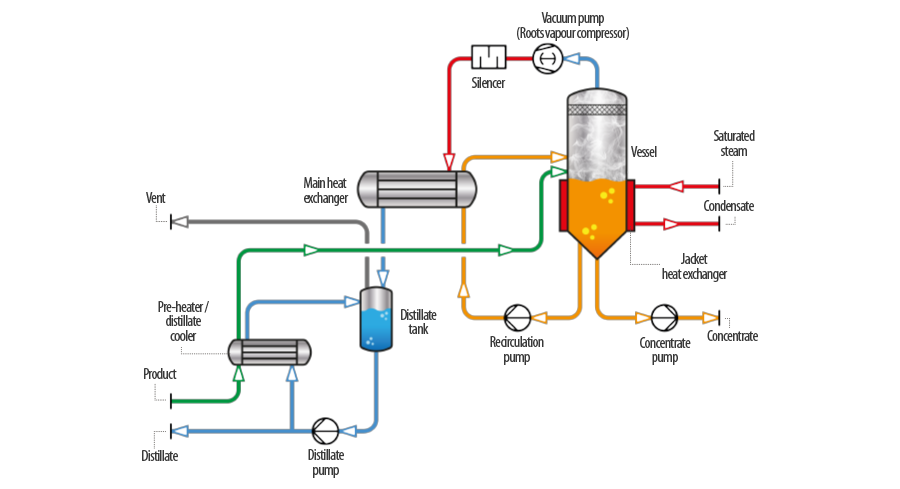
The following video showcases the DESALT MVR FC evaporator/crystallizer. The video highlights all the main components and benefits of mechanical vapor recompression systems.
OPERATION OF OUR MVR CRYSTALLIZERS
Feed introduction and operating conditions
The wastewater enters the system and is brought to the required operating temperature and vacuum conditions. Where fitted, a preheater uses recovered heat to warm the incoming feed. Auxiliary heating may be required during startup until sufficient vapor is available for recompression.
Heat exchange and evaporation
A circulation pump moves the liquid through an external heat exchanger, where it absorbs heat, and back into the evaporation chamber. Under the lower pressure in the chamber, part of the water evaporates. As water is removed, the solution becomes supersaturated, allowing salt crystals to form and grow.
Mechanical vapor recompression and heat reuse
The generated vapor passes through a droplet separator before entering the compressor. Compression raises its pressure and condensation temperature, allowing it to serve as the heating medium in the external heat exchanger. There, it releases heat to the circulating liquid and condenses into recovered water.
Condensation, recovery and crystallization
The condensate is collected for potential reuse, subject to the required water quality. A portion of the crystal slurry is withdrawn for solid–liquid separation, while the remaining suspension continues circulating. The separated mother liquor can be returned to the process or managed separately, depending on its composition and the system design.
3D VIDEO ANIMATION
The following is a 3D video animation that shows step-by-step how our mechanival vapor recompression evaporators work, from the feed of the solution to be treated into the evaporator/crystallizer until the distillate and concentrate are extracted from the system.